

How Do You Breathe Through Life? A Guide to Breath Techniques That Shift Your Mind, Body, and Nervous System
Learning How the Science of Breath and Pranayama Can Cultivate Awareness, Reduce Stress, and Help You Move Forward with Greater Ease

Insight from the Mat
Last month, for my birthday, my sister took me on a weekend getaway to Port Gamble, a charming coastal town in the Pacific Northwest. We spent the afternoon enjoying the crisp sea air, wandering through local shops, and eventually settling in for a bowl of clam chowder at a cozy café. Over lunch, I shared my next article idea—breathwork—and how I wanted to explore the science behind the yoga breath.
That conversation took an unexpected and enlightening turn. My sister, a nurse, lit up and began talking about her experience working with newborns. She described the profound importance of a baby’s first breath, and how it marks the transition from the womb to the outside world. It’s more than just oxygen—it’s the body’s first act of independence, the first movement of life itself.
I had never thought of breath as our first act of independence!
I was instantly hooked. As someone who has spent years studying and teaching breathwork, I had never truly considered the first breath—the very thing that sets everything in motion. Could that initial inhale be a symbol of how we engage with life? If our first breath carries us into the world, what does that say about how we breathe through challenge, joy, effort, and stillness?
This got me thinking: What if we approached breath in everyday life the same way? What if we could tap into its rhythm to fuel our focus, movement, and emotions?
As we dive into One Full Breath Cycle and explore the many breathwork techniques, I invite you to reflect:
→How do you breathe through life?
→And how can the breath you choose today shape the way you move forward?
The Breath That Shapes Us
In yoga, breath is more than just air moving in and out of the lungs—it is Prana, the vital life force that animates every cell, organ, and emotion. The Sanskrit word Prana translates to breath, life force, or energy, while Yama means practice, discipline, or control. Together, Pranayama is the intentional regulation of breath to influence the mind, body, and overall state of being.
While modern science describes breathing as the exchange of oxygen and carbon dioxide, yogic wisdom teaches that each breath carries energy, capable of shifting our physical, mental, and emotional state.
That conversation with my sister stayed with me, making me reflect even deeper on the significance of our first breath—the very moment we transition from dependence to autonomy. In her work with newborns, she sees firsthand how this first inhale marks the transition into life outside the womb, setting the body’s independent systems into motion.
Before birth, a baby’s lungs are dormant, filled with fluid, and rely on the placenta for oxygen exchange. But the moment they take their first breath, a powerful surge of negative pressure draws air into the lungs for the first time, clearing the fluid and triggering the body's shift to self-sustaining respiration. This moment, both biological and symbolic, marks a bridge between the internal and external world—between dependency and autonomy.
Breath sustains life, but more than that, it shapes our experience. While our first breath is miraculous, each breath that follows becomes an automatic cycle, an amazing function of the human body that allows for effortless respiration but simultaneously enables habitual patterns. Over time, this unconscious breath pattern adapts to our mental, physical, and emotional environment, influencing our nervous system, mental clarity, emotional state, and overall vitality.
With every breath, we influence our well-being. The way we breathe throughout life is something we can control, refine, and harness. Through Pranayama, the practice of breath control, we shift from passive breathing to actively shaping our well-being—using breath as a tool for balance, focus, and resilience.
Breath as a Tool for Restoration and Resilience
As a yoga therapist, I have been honored to witness how the breath supports both the physical and mental states of being. Watching an anxious, tired student step into an evening class, I see firsthand the transformation that unfolds. With each deliberate movement and breath, their body softens, their breath slows, and their mind quiets.
By the end of class, their entire presence has shifted—whether we call it energy or something else, there is no doubt that their nervous system has settled into a calmer, more balanced state. Through movement (asana) and breathwork (Pranayama), they are no longer just breathing automatically—they are engaging in breath control, harnessing it as a tool for restoration and resilience.

At the foundation of Pranayama is One Full Breath Cycle, a rhythmic process that every breathwork technique follows:
1️⃣ Inhale → The breath enters, oxygenating the body and creating energy.
2️⃣ Stay Above the Inhale → A brief pause to absorb and settle into the breath.
3️⃣ Exhale → The breath leaves, releasing tension and creating space.
4️⃣ Stay Below the Exhale → A moment of stillness, deepening awareness before the next inhale.
Every breath technique—whether for calming the mind, increasing energy, or deepening focus—is built on this cycle. Through the practice of Pranayama, we learn to consciously shift how we feel, think, and respond to life.
For centuries, yoga teachers, healers, and medical researchers have explored how manipulating the breath can alter physical, mental, and emotional states, influencing everything from stress levels to cognitive function. Through controlled breathing, patterns can be rewired, behaviors reshaped, and well-being optimized.
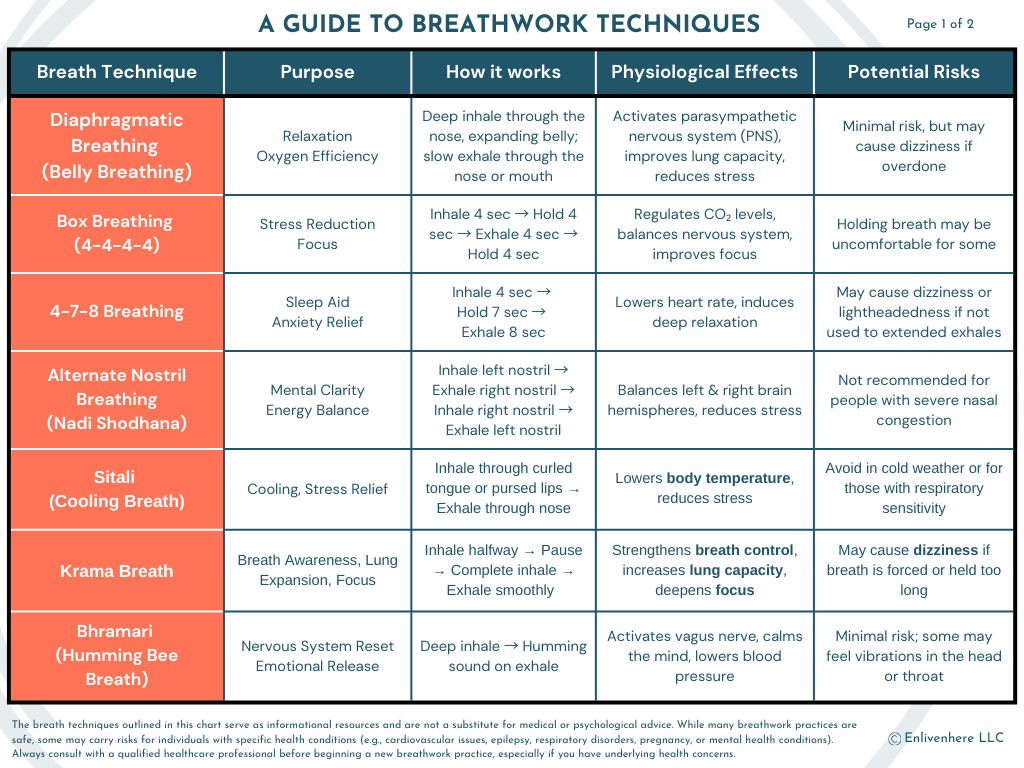
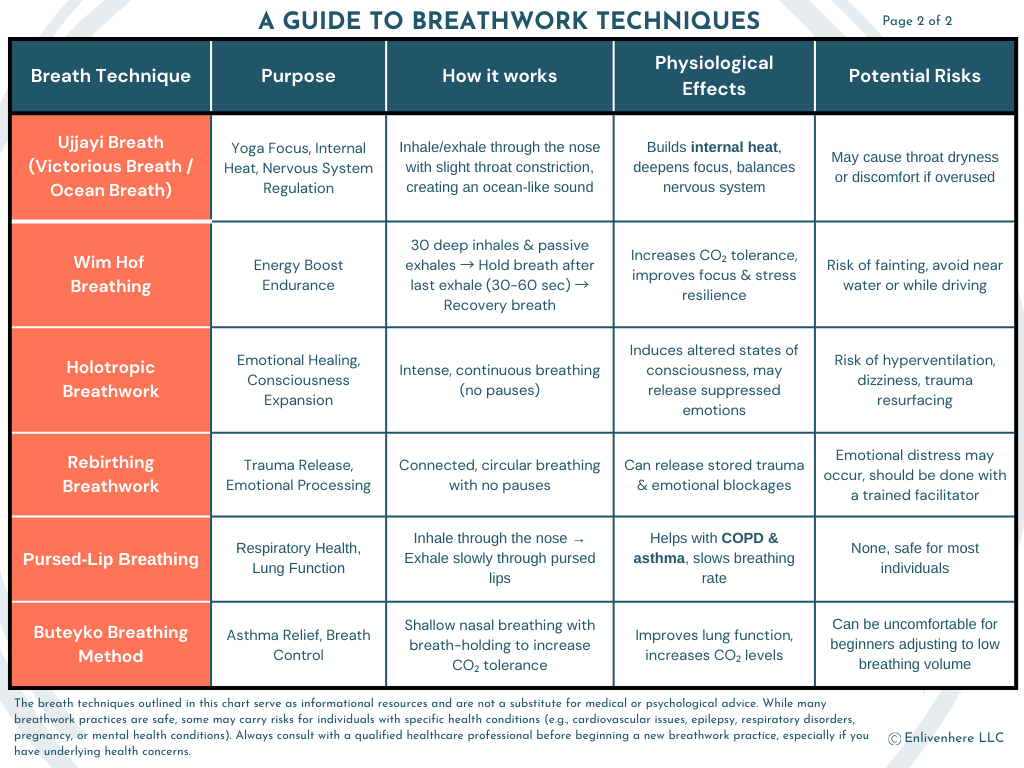
The following chart highlights a range of breath techniques, demonstrating just how powerful the breath can be.
Breath “off the Mat”
Reviewing and selecting these breath techniques has reinforced something I’ve long understood intellectually—breath is powerful, and its impact on our health is profound. Writing about it here has underscored just how much conscious breathing shapes our mental and physical well-being.
Think about your daily life—do you work in a stressful environment? Do you know someone who does? How do they breathe under pressure? Many of us hold our breath without realizing it, especially under stress. Shallow, rapid breathing becomes the norm, reinforcing a state of tension. Conversely, in moments of peace, breath naturally slows, deepens, and softens—our bodies reflect our inner state.
As awareness grows, more companies are integrating mindfulness and wellness programs to help employees manage stress. Research shows that structured breathwork and meditation interventions can enhance focus, lower stress, and improve overall health.
Breath doesn’t have to be automatic all the time—it can be our most vital tool to change how we move through life.

My Closing Insights: Let Breath Lead the Way
Throughout my years of practice and teaching, I have been honored to witness the profound connection between breath and movement—not just in my students, but in myself. In writing this article and exploring over ten different breath techniques, I kept returning to my initial questions:
How do you breathe through life?
And how can the breath you choose today shape the way you move forward?
These questions are, in many ways, the response to our "why"—why we come to the mat, and why we practice. The answer is woven into the question itself: to move forward, to reduce suffering.
In most classes, the focus naturally falls on asana (physical postures). I understand why—we relate to our bodies more than to our breath. The body is tangible, something we can see and feel. Breath, however, is more subtle, often overlooked in its quiet constancy. Asana may be the first point of connection, but here, I suggest a shift: make the breath the guide and let the body follow.
When the breath leads, something powerful happens. Movement slows, awareness deepens, and the body begins to respond with greater ease. The habitual patterns we carry—how we walk, sit, and even hold tension—are as automatic as our breath. By bringing attention to One Full Breath Cycle, we create an opportunity to pause, feel, and witness the natural rhythm within us.
On the mat, I invite you to be led by your breath cycle. Feel the sensation of air entering your lungs. Observe the subtle movements of your front body—the gentle rise and fall, the space that expands and contracts with each inhale and exhale. In doing so, you may find that your desire to move forward comes with more ease, and the tools cultivated on the mat become more accessible in daily life.
To experience this shift for yourself, join me in a five-minute Pranayama practice where we will move through One Full Breath Cycle together. Breath has been guiding you since the very first moment of life—let’s bring it to the forefront, allowing it to shape the way you move forward.
▶
So inspiring, Amy! ☺️
I love this, Amy! One of the topics that come up in my coaching sessions the most often is how we get out of our own way. By putting effort into breathwork, you can learn to reframe your thoughts to let go of negativity. There is that saying, "What would you do if you knew you could not fail?" The simple act of learning how to breathe can change the way we look at life. There are no more failures but incredible opportunities.